Volume 5, Issue 1, February 2024
|
|
|
|
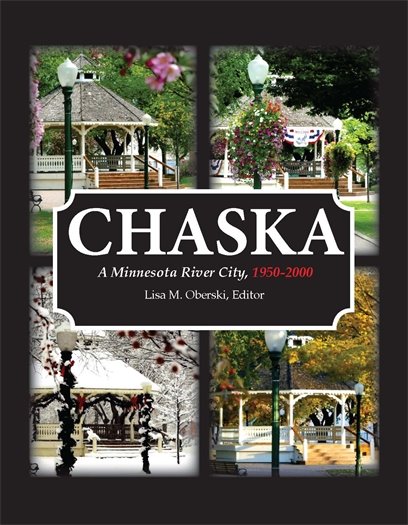
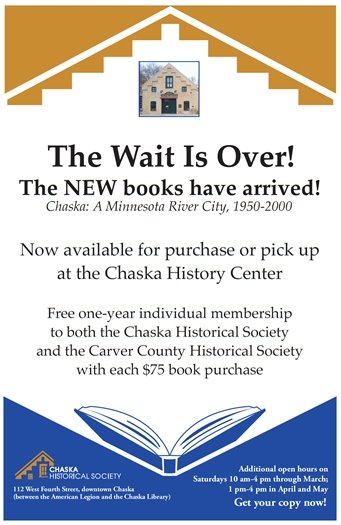 The wait is over! The new books have arrived! Chaska: A Minnesota River City, 1950-2000 is now available for purchase or pick-up at the Chaska History Center. Free one-year individual membership to both the Chaska Historical Society and the Carver County Historical Society with each $75 book purchase. Get your copy now! Additional open hours on Saturdays:
10am - 4pm February - March
1pm - 4pm April - May |
|
|
|
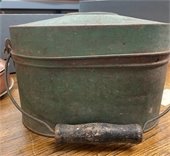 A lunch pail formerly belonging to a Chaska brickyard worker is saved in the collection. |
The Collections Room at the Chaska History CenterBy Society volunteer Julie Wiese In these dark, frigid days of winter, as we sit in our warm and snug homes, it would behoove us to think back decades ago to the people who lived on this very same land, but in very different homes. How did they keep warm? How did they cook? How did they stay safe? Their houses had to be filled with “stuff” that ensured their survival. I wonder what happened to all that “stuff”? Well, most of it aged, broke and was thrown away. However, a fraction of it was passed onto children, grandchildren, great-grandchildren and resides today in a special place in Chaska, the archive room of the Chaska History Center.
In what used to be an old livery stable, built of brick, tucked away between City Hall and the American Legion, up on the second floor, where the hay used to be stored, you will find some of that “stuff” that use to fill the world of old Chaska: spittoons, World War II ration cards, wooden egg crates, home-made rocking chairs, a civil war sword from the 1860s, pitcher and wash basin, wedding gowns from long ago, vintage hats from a time when women never left home with an uncovered head, photographs of the original pioneers of Chaska, antique toys played with by the settler children.
|
|
|
|
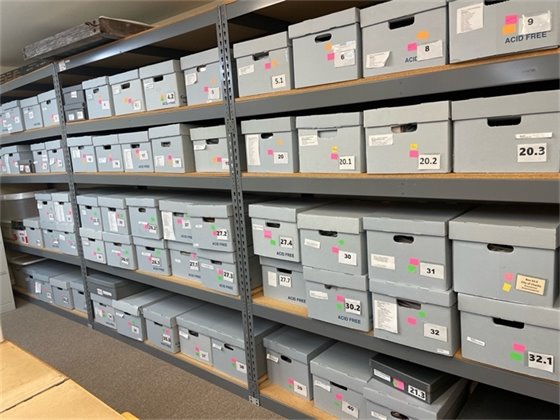 Boxes and boxes of Chaska treasures found in the Collections Room are all in our database at the Chaska History Center. |
|
|
|
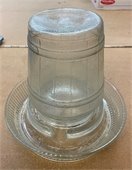 An old chicken waterer in our collection, from a time when Chaska had several hatcheries. |
This is the archive room of the Chaska History Center, with over 4000 artifacts and 9000 photographs, and all the original copies of the Chaska Herald going back to 1862. So many people have donated objects from their ancestors who resided in and near Chaska. There are scores of boxes lining two walls filled with artifacts from another era. Taking one box down and opening it up, there is found a copper bed warmer, looking like a frying pan with a long handle, which was filled with embers and placed under the covers of the bed. (Yikes!). Another artifact is the glass chicken waterer. To keep the hens hydrated, the glass jar was inverted over the glass bowl. The owner of the metal lunchbox with a wooden handle, circa 1930, was once a worker in one of the Chaska brick yards. If you have something in your attic, or your mom’s attic, that you think could find a home at the archive room at the Chaska History Center, bring it down and we will take a look.
|
|
|
|
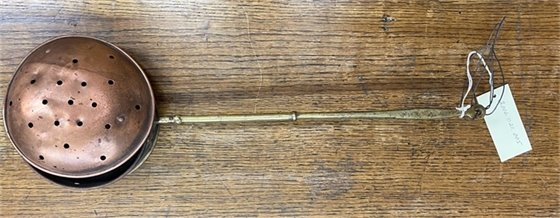 A bed warmer hearkens back to bygone years. |
|
|
|
Ewer and Basin – A History MysteryBy Society Volunteer Ruth Travis |
|
|
|
Editor’s note: Society volunteer Ruth Travis weighed in on one of the many items on display for the “Will you live to be 100? A Retrospective on Health and Wellness in Chaska.” Her valued insight into the likely creation of Magdalena Lubansky’s ewer and basin (pitcher and bowl) further highlights the importance of Lubansky’s role in the community during her long tenure. Thank you, Ruth, for sharing this important information!—LO
|
|
|
|
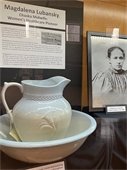
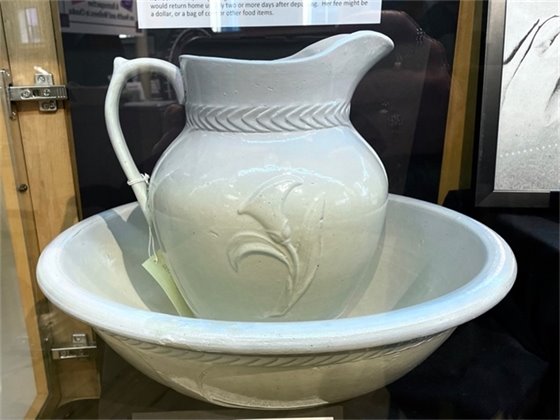
As a retired nurse and visitor passing through the Chaska History Center, I was drawn to the display celebrating Magdalena Lubansky’s career commitment to midwifery in Chaska. I was also intrigued by the ewer and basin (pitcher and bowl) displayed among her personal possessions. Just as Chaska celebrates the history of your clay brick industry, I, having grown up in Goodhue County, have long been interested in the evolution of the stoneware industry of my area. I believe this ewer and basin were both designed by and produced by Red Wing Union Stoneware. As such, I questioned the wording of the label displayed with this beautiful (and very difficult to find in the collector’s world) washstand set. The current display label states the “bowl and matching pitcher accompanied her throughout her 50-year career as a midwife.” Magdalena Lubansky began her career as a midwife in 1890, but this set would not have been produced until much later. A little history -- Many of us have admired lovely porcelain or ceramic washstand sets used in the by-gone days before indoor plumbing made them obsolete. This set was actually made of a heavier stoneware clay, requiring a much higher kiln temperature than porcelain, ceramic, or art pottery. Prior to the early 1900’s, stoneware kilns were fired by wood or coal. The crocks, jugs, and kitchenware produced were generally Albany slip (brown) or salt glazed, a process by which salt was thrown into the kiln during firing and the oxidized salt combined with the airborne ash to create the rich tan coloring common to earlier crocks and pottery. Smaller white glazed pieces were first fired in Red Wing, MN around 1897. When potteries began converting to oil burning kilns in 1900, the soot impurities problem inherent to airborne ash was resolved and the white glaze on stoneware of this size became possible. |
|
|
|
|
|
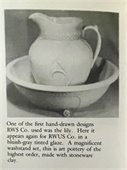 This photo of the set is in someone’s collection. The photo appears in Lyndon C. Viel’s first of three The Clay Giants books, copyright, 1977. He repeats the same photo and caption in Volume 3, copyright 1987. He does not identify the year of production for this set. |
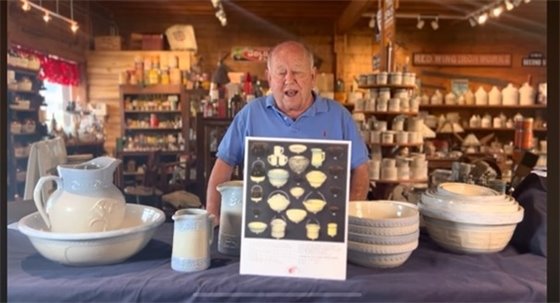
The blue gray accented pieces (Blue Tint), like this set, were first produced around 1915. The lily ewer and basin, though, are not offered in the 1918 catalog listing of blue tint pieces. They are, however, noted in the 1930 Red Wing advertising poster. There are a number of other dating clues I could elaborate and will continue to research, but I believe the probable production timeline is narrowed down to an 11-year window from 1919 thru 1930, a full 29 to 40 years into Magdalena Lubansky’s notable career. In that this stoneware set is heavy and would not likely have survived frequent transport in Minnesota weather over county roads, I can’t imagine Magdalena Lubansky would have taken it out on labor and delivery calls. More commonly, people would have used enamelware bowls and pitchers in their homes for everyday use throughout her years of service. Enamelware was economical, didn’t break, could be heated or cooled, and was lightweight to transport to and throughout homes. Mrs. Lubansky’s set is special and a relatively limited number are known to remain. In a 1982 valuation guide, Clay Giants author, Lyndon C. Viel, identified this “Wash Stand, Lilly Set, blue gray” among a list of pieces produced by Red Wing Union Stoneware (which operated as RWUSCo from 1906-1936) and noted that he personally knew of only 4 among avid collectors. We now know there are more, but they are treasured, and I can’t help but wonder how Magdalena Lubansky came to own this beautiful set. Was it a gift from relatives or perhaps a grateful patient? Could it have been a recognition from the community she served? The mystery remains, but I do believe this ewer and basin would have been a prized possession in her home, were a part of her life, and are truly lovely pieces to display as a part of telling her remarkable story. Want to know more? Here’s a link to a talk by Larry Peterson specifically on the blue tint process:
|
|
|
|
|
|
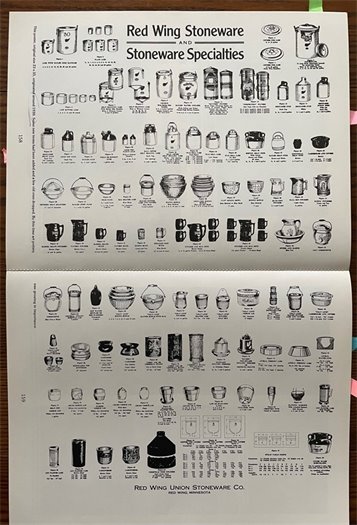 The advertising poster (in lieu of catalogs) is repeated frequently in many pottery books and broadly reproduced for online purchase. It is identified as 23” x 35” and as having “originated around 1930” in multiple sources. This one came from Red Wing Potters & Their Wares, Third Edition, by Gary and Bonnie Tefft, copyright, 1996 |
|
|
|
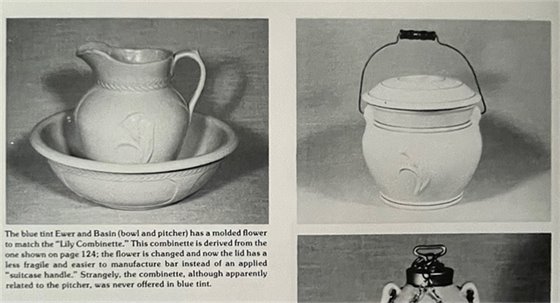 The side by side photo of “The blue tint ewer and bowl…” and combinette (chamber pot) are from the Red Wing Potters & Their Wares, Third Edition, by Gary and Bonnie Tefft, copyright, 1996. They also do not identify the years of production for these pieces. |
|
|
|
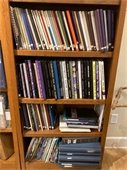 Our collection of school yearbooks provide ample opportunities to reminisce! |
A Glimpse into Some of Our Artifacts:
Our High School Yearbook CollectionBy Lisa Oberski, society volunteer During a time of the year when winter seems interminable, thinking about spring and warmer weather can bring a lightness to our step and an anticipation for those longer days and fewer layers of clothing. I assure you: It’s coming. In the meantime, consider stopping by the history center to explore our high school yearbook collection! It’s a fabulous trip down memory lane, and a good reminder of how you connect with your community. We have Chaska High School (later Eastern Carver County Schools) Hawk year books from 1948, all the Guardian Angels yearbooks prior to the high school closing in 1973, a smattering of elementary and middle school yearbooks from both public and private schools in the area through the years, and are beginning a collection of Southwest Christian High School yearbooks. Even if you didn’t personally attend the local schools, you may have a child who does or did, or other connections to the thousands who have graduated in Chaska. Perhaps you’ll see your neighbor’s graduation picture, or that photo from those awkward middle school years. Think of that cheesy grin you can tease them about, or be awed by the number of former students who returned to the district as teachers! Oh—and if you happen to have the 1977 Hawk, we’d be VERY interested in adding it to the collection—it’s the ONE we don’t have. The passing out of yearbooks is one of those spring traditions that most can remember from high school. Look forward to the return of spring by passing the cold days with some warm memories recorded in our yearbook collection!
|
|
|
|
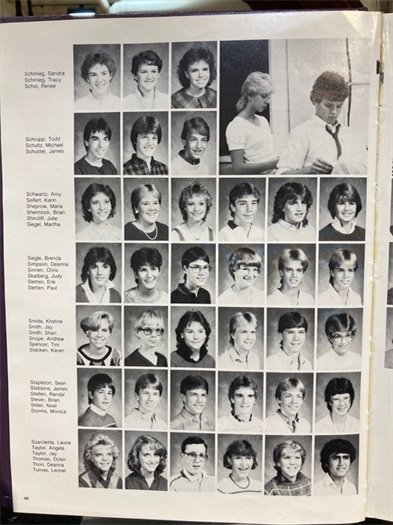 A glimpse into the 1985 Hawk yearbook from Chaska High School. |
|
|
|
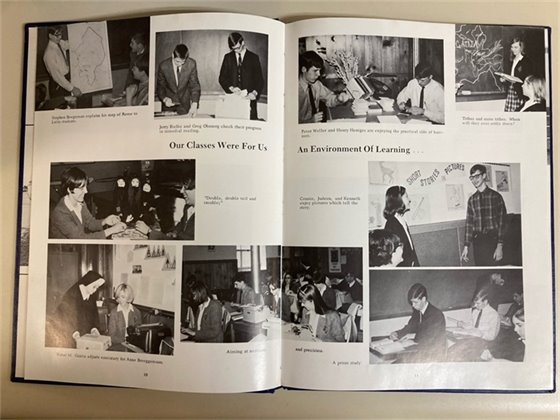 The 1968 Angelyte yearbook from Guardian Angels High School gave some highlights on some of the classes offered. |
|
|
|
|
|
Where are we Headed? The Chaska Historical Society's Organizational Priorities for 2024
It’s an exciting time! We, the Chaska Historical Society, have SO MUCH to look forward to in 2024! What’s changed? The biggest change is that for the first time since 2015, we have NO huge book project in front of us! During the reprinting the first two Chaska: A Minnesota River City books as one combined volume (Prehistory to 1950) in 2019, we had already begun the monumental task of researching and writing Chaska: A Minnesota River City, 1950-2000. As of January, 2024, that book is DONE. Those two huge, dark clouds are no longer over our heads—we can now plan on our next steps as an organization in this community we call Chaska. As part of that process, the Board of Directors of the Chaska Historical Society determined that our vision and mission statements and list of objectives needed to be reviewed and modified. With the role of museums and the styles of volunteering changing, we needed to consider how our organization can best fulfill the needs of our community while attracting and supporting more volunteers. A major conclusion was that we can no longer simply focus on collecting and exhibiting artifacts from past years, especially during a time when our traditional means of collecting history (newspapers and other sources deemed reliable) are disappearing. After much discussion, we chose new vision and mission statements: Our Vision: We see a Chaska community where all are valued. Our Mission: We’re connecting people to Chaska history in a way that is accessible and relevant. With these vision and mission statements in place to guide us, we were able to set our objectives—our organizational goals—for the next six years (until 2030): 1. By 2030, we will increase our connections to Chaska youth and adults so that 1,000 people in each group will have some contact with Chaska history programming each year. 2. By 2030, we will design a comprehensive and sustainable local historical information gathering system to ensure we have contemporary collecting for the future. 3. By 2030, we will create, maintain, and expand a successful volunteer recruiting and retention plan so that the number of volunteers choosing to contribute rises from ~30 to ~50. 4. By 2030, we will partner with ten organizations to research their history for sharing with the community. 5. By 2030, we will have enough funds in our Community Foundation accounts to sustain, through their earnings, two part-time staff positions (executive director and collections manager) for organization sustainability and stability.
|
|
|
|
Lofty goals, ‘tis true. But very much worthwhile ones. How do we do it? Just as our volunteers have done it all along: A little bit at a time, and with hard work. Let us know if you’re interested in helping us accomplish any part of these goals—we’d appreciate both hands-on and monetary support! We can be reached at historical@chaskahistory.org or 952.448.6077.
|
|
|
|
|
|
Chaska: A Minnesota River City, 1950-2000 Hits the Market!
|
|
|
|
1950 to 2000. It was a time of extreme change within Chaska–from physical size and population to city council changes; from solely paper and pencil to a computer-laden world; from a community supported by local agriculture to one supporting the high-tech and biomedical world; from a downtown filled with Mom and Pop stores hawking their wares to a broadened community with Big Box stores and the very beginnings of Amazon.com. And that’s just some of the major changes. There was the advent of Jonathan, and its eventual transition to become the largest HOA in Minnesota. Jonathan brought in new ideas and new ways of thinking about things, which allowed the community to grow into its parks and trails richness. There was the change in the schools, from about sixteen small school districts in eastern Carver County to one district–Eastern Carver County Schools–which was known for most of that fifty years as Chaska Public Schools. The public school had all twelve grades in one building to a high school anticipating the need to divide in half due to sheer size by 2000. It went from one private high school, to none, to a new one. It started with a time when high school sports and activities were THE THING, because there wasn’t really much else to entertain the community. The high school activities brought the community together, much like the faith communities at the time (the three downtown churches were all there were until Crown of Glory opened in 1968). The civic organizations like the Lions and the Legion and VFW also built the community, and ALL worked hard to lift everyone up during the times of disaster caused by repeated floods in the 1950s and 1960s. The 1950 to 2000 time was an amazing time for Chaska. After 100 years of a stagnant population of 2,000 people, that time period created the foundation for a new normal, one richer and more diverse and better able to adapt to change than ever before. Chaska: A Minnesota River City, 1950 to 2000 records what happened and how it happened. Pick up your copy now! |
|
|
|
|
|
|
|
|
|





 Share on Facebook
 Share on Twitter
 Share via Email
