Indexing, Thoughts On
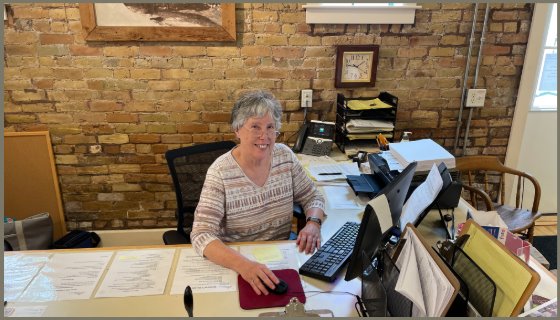
By Marilyn Savelkoul Gahm
EDITOR'S NOTE: Marilyn was the indexer of the original two-volume Chaska history books, plus Volume I and Volume II, of the Chaska Historical Society, and the Andrew Peterson diaries published by the Carver County Historical Society – plus more books and magazines.
Making an index to a book or magazine creates a bridge – or translation - between the mind and language of an author and the needs of the reader/user.
In library school, I learned that a reference book without an index was considered useless. No index = no easy access to the information in the book, making it difficult or impossible to find. Today, with online digital books, you can search a specific word – but often not complex meanings or spelling variations, and you’d miss a reference to your person of interest when the reference was to “she” (who?).
The indexer’s job is to interpret the writer’s language into the reader’s language. An indexer is always balancing between “what did the writer mean?” and “how is a reader going to approach this?”
It is easy enough to prepare a name index to a book, you might think. “Smith, John” – easy, right? Not so much for historical books, which may use original sources – and their original (faulty?) spellings. Is “John Smith” also Jake Smith, Jack Smith, John S. Smith, J.S. Smith, John Smithe, John Smythe, John Smith Sr. or John Smith Jr.? In addition to the variations caused by original and incorrect print sources, name variations escalate when the additional challenge of reading “old (or any) handwriting” is added.
The form of a personal name is a challenge. Sometimes after the final whittling down is done, there are still some name versions that cannot be verified, so your index may include “Smith, John” and “Smith, Jack” – who may be the same person.
Names of entities – Klein Bancorporation, Klein Bank, KleinBank – can also vary over time, and between sources. And which City Hall or County Courthouse location in Chaska did you mean?
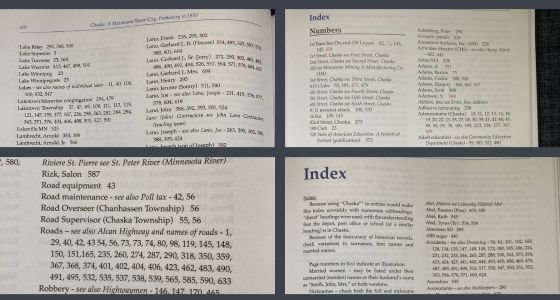
Another challenge is the question of “too much vs. too little.” With what level of detail do you challenge a reader? Do your subject headings need subheads or clarification? Volume II of Chaska history covered a lot about sports – at the local schools (Chaska/Guardian Angels), plus recreational leagues, sports venues and professional teams. An index entry like “Baseball” would have produced a lengthy string of page numbers. An index user would have faced the lengthy task of looking up each page entry in the book to see if it was useful. Subdividing Baseball into headings like “Baseball (Chaska High School boys)” significantly decreased a reader’s pain – while increasing the indexer’s work.
Even after reading the text beforehand, I have never failed – some pages into a book – to realize that I was under-indexing (too broad) some topics and over-indexing (too narrow) others. Ah, start over! Decide on a different level of detail and review my work. Sometimes this enlightening occurs at the very end. Is there way too much subdivision of a term used only a few times? The final index is a balance between condensing into less and differentiating more.
Then the “guilt trip.” An indexer knows if a term is missed, it is lost FOREVER. I know I’ve made errors in the 30+ books I indexed, but I sure tried hard not to, because of this responsibility.
Before computers, I indexed using the appropriately named 3x5 “index cards.” That was painstaking. Each entry got a card (handwritten subject, subhead, page), the cards were sorted alphabetically, then condensed (sometimes discarding subheadings), then typed. More room for error, more time at the end of the index process sorting cards and determining headings. And losing even one card? – lost forever.
Once computers were available, I used the Excel program to index. Excel sorts entries alphabetically, and automatically begins to fill in the header in a column, although you do have to retype the numerous page references to, say, the “clayholes” onto one line if you don’t want to keep the index in its original Excel table format. As you can guess, I index “as I go” – making subject headings and page notes for each entry as I read it, then sorting and consolidating entries at the end, rather than searching back into an Excel file to find where the term was used previously and adding a page reference. With a lengthy book, that process would take months! You can also create a table in the Word program, and sort it.
Professional computer indexing programs are available, but I get by with Excel, although the final product usually has to be converted into a more easily read format. Of course, you can – and I have – kept some indexes in their original Excel table format. Or you can try a Word table format.
An interpretation/translation requirement is the use of “see” and “see also” references. Not only is an indexer translating a writer to a reader, but you the user cannot read the mind of the indexer, so my mind must be made accessible to you.
A “see” reference (or several of them) sends a user from a term the user thinks is a good starting point to the term the indexer chose to use. If you remember Chaska had a drum and bugle corps, you look up “drum & bugle corps.” The “see” reference sends you to the names of the two musical units that existed in Chaska. And what was the name of the “pickle factory?” I tell you to see M.A. Gedney Co. And if you looked up “Gedney,” you’d have been directed to the official name of M.A. Gedney.
Did I use First Ward or Ward 1 for a Chaska political division? The “see” reference will tell you.
Perhaps you look up “Parks” in the index, where you find a “see also” reference to the names of 28 parks and Chaska’s Parks and Recreation Department. It would have been a disservice to a reader to type an enormous list of page references for all those parks into one list, so separate park headings were made. But since you the reader cannot know all the parks that existed in Chaska, the indexer jumps in to help you.
In a book devoted to a single topic, like Chaska, it’s best to avoid beginning headings with that word. Which is why you’ll find the Chaska Parks and Recreation Department under “Parks and Recreation Department.”
An indexer needs the talent to think in “subject headings” – and in reverse. I chuckled – and groaned with dismay – when I consulted the index of a book on starting a restaurant. The restaurant book index failed the reader when it used the subject heading “Making a menu” instead of “Menu, making a.” Who looks up “making”?
When I indexed several monthly Twin Cities business magazines for several years, I needed a way to keep myself consistent over time so I created a subject heading list. The list consisted of “see” and ”see also” references, and the subject heading I had chosen to use. After I had jotted down subject headings and pages in a computer file, I would look up each heading in this list, to see if that was the previously used term, or if I had forgotten and chosen the “wrong” subject. If you index a recurring publication, I recommend a master referral list. When I indexed Volume II for the Chaska Historical Society, I referred to Volume I for the headings – and “see”/”see also” references I used previously. One caution: language changes over time, so you may need to adjust your subject headings, and add more “see” and “see also” references to accommodate terminology changes or language that has become unacceptable in society. You may wish to “shut down” a subject heading, and add a note like “Heading [used through 2023]” and “Heading [used 2024 and following],”
Making an index is often hard, frustrating, time-consuming – but oh! so all worth it, when an indexer delivers a product that opens the door to a wealth of information.
After writing this article, I found an article titled “The Pleasures That Lurk in the Back of the Book” by Alexandra Horowitz, published in The Atlantic of March 16, 2022. Always nice to find someone who agrees with you! The author is an admitted lover of “the humble index – expediter of searches, organizer of concepts.” She wrote: “Indexes offer the reader multiple ways in and through the text.” Horowitz references a book by Dennis Duncan with a clever title: Index, A History Of the – and noted: “The history of indexes, as Duncan tells it, is also a history of alphabetical order, chaptering, and the advent of page numbers.” Found it fascinating that page numbers were only introduced in a 15th-century printed book. (Can’t index without ‘em! – although I have more than once been asked by a publisher to index a book BEFORE the page numbers were assigned. Sorry, “no.”).
An author herself, Horowitz wrote, “After the manuscript is completed comes a thrilling day when I am sent my own book’s index – the person who compiles it is the first reader who isn’t invested in the book. The topics she pulls out, how she cuts the conceptual lines, are more than a concordance of words; they are her interpretation of the landscape of ideas in the book.”
I like the image of an indexer as a tour guide of a book’s landscape.